“My Best Work Is My Next Painting”
From Moonstone to Magic: The Gathering, legendary fantasy artist David O’Connor reflects on a lifetime spent creating worlds.
I finally tracked down David O’Connor in 2018 via his agent Guy Coulson; it had taken me years (I think I started looking at least a decade earlier, if not more.)
I originally had a simple goal: to learn more about the artist responsible for Moonstone’s iconic cover and map artwork, and discover where those two beautiful oil paintings had disappeared to… because surely they had been snapped up, hadn’t they?
What followed was an adventure worthy of Sir Godber himself.
Not only did the elusive David prove every bit as talented and thoughtful as I’d hoped, but I somehow managed to end up owning both of the original paintings. Sometimes, dreams do come true!
Now, with Moonstone AGA underway and gathering momentum, it felt like the perfect opportunity to catch up with David once again.
What followed was less a discussion about Moonstone and more a fascinating journey through a lifetime of illustration, creativity, passion, self-doubt, changing technology, and the enduring joy of putting physical paint to physical paper.
I hope you enjoy reading it as much as I enjoyed speaking with David.
“I Couldn’t Believe They Were Paying Me To Sit And Draw”
David’s journey began at school.
A talented young artist, he credits an inspirational art tutor with helping him pursue a creative career despite concerns from parents and teachers urging him towards something more conventional. Without that support, he jokes, he might have ended up with:
“a proper job and a proper pension.”
Instead, he went to art college… and loved every minute of it.
“I remember arriving on the first day and thinking I couldn’t believe the government was paying me to sit and draw.”
That early confidence quickly translated into professional work. While still studying, David was producing illustrations for the Radio Times, exposing his artwork to millions of readers every week.
“It gave me a lot of confidence that I’d made the right decision.”
Learning To Trust Himself
Like many creative types, David experienced periods of self-doubt. One particularly important turning point came when he discovered the work of celebrated American illustrator James Bama, which proved transformative. Looking through Bama’s paintings, David realised that the highly detailed, hyper-real style he loved wasn’t something he needed to apologise for or justify.
“It made me realise I didn’t need to question it anymore.”
Another key influence was legendary fantasy illustrator John Sibbick. While working on a major book project, David found himself agonising over every sketch and rough drawing. Sibbick’s advice was simple:
“They commissioned you because they want you. Stop trying to please them. Please yourself.”
The impact was immediate.
“It was like a lightbulb going off.”
Decades later, David still remembers the lesson.
The Moonstone Commission
Unlike many of the projects that followed, David’s memories of the original Moonstone commission are surprisingly hazy.
After more than three decades, he freely admits some details have become impossible to separate from speculation. One name that surfaced during our conversation was Ivan Tyrell, a Brighton-based creative who David believes may have been responsible for bringing the commission his way.
Whether through Tyrell, an agent, or another contact entirely remains something of a mystery. What David does remember is the work itself. The Moonstone cover and accompanying poster map demanded considerable time and effort.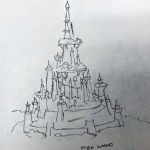
“I was determined to make it as good as I possibly could.”
That certainly shows, especially in the intense detail of the final work – where many elements of Moonstone’s game lore reveal themselves.
The cover, meanwhile – while divisive among some fans and even Moonstone’s creator Rob Anderson (‘why can you see the knight’s face?‘) – remains one of the most recognisable pieces of fantasy game artwork of the Amiga era, combining humour, jeopardy, and atmosphere in a single playful image.
One detail David still particularly likes is the central composition. Our brave quest knight has finally discovered the Moonstone. Unfortunately, he’s also about to have his head bitten off by a dragon.
In that sense, David and Rob Anderson are probably more alike than they realise.
The Mystery Of The Gnome
One of the joys of speaking to David is that not every question has an answer, and that the passage of time impacts lots of things – including memory!
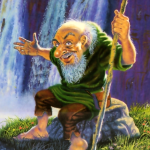
Take Moonstone’s famous gnome. Even after all these years neither David, nor Rob Anderson, seems entirely sure why the little fellow found his way into the artwork. David suspects he must have received some kind of direction. After all, he says, he wouldn’t normally have added a random gnome entirely of his own accord.
Then again, memory is a funny thing. Thirty-five years later, this rather lovely mystery remains unresolved.
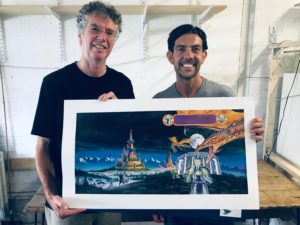 Rediscovering The Lost Artwork
Perhaps my favourite part of this story is what happened decades later, and my role in it!
Like many illustrators of the period, David retained ownership of the original paintings after publication. Once the work had been reproduced commercially, the physical artwork simply came home with him (Sorry, Rob A).
One of the paintings – the poster map – eventually ended up hanging on a wall in David’s home. The other disappeared into a storage chest. Neither had seen much attention for decades, before a slightly obsessive Moonstone fan (ahem) started asking questions.
To David’s credit, he patiently endured my increasingly excited emails and I – over a period of years – acquired both works.
How’s that for a happy ending?
Art In The Age Of AI
No discussion with a working artist in 2026 would be complete without touching on AI. David’s views are nuanced; he isn’t opposed to technology. Far from it. Like many professionals, he’s embraced tools such as Photoshop and digital workflows that make certain aspects of the creative process faster and more flexible.
But generative AI presents a different challenge. Perhaps most strikingly, David isn’t worried for himself – he’s worried for young artists.
“If I was 30 now, I’d be petrified.”
For somebody who’s spent a lifetime painting physical objects in the real world, the idea of replacing brushes and paint with prompts and algorithms feels fundamentally different.
“The only thing I’m really interested in is producing a painting.”
It’s difficult not to admire the simplicity of that sentiment, but I do wonder how many future generations will enjoy that same freedom.
Still Painting At Seventy
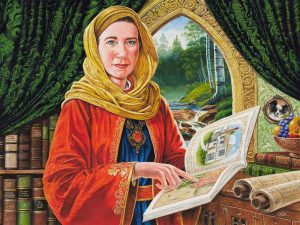 One thing became increasingly clear throughout our conversation. David isn’t slowing down.
At seventy, he still paints. (Lots!) Still creates. Still experiments. Still takes on stunning commissions (like the one on the left). Still talks enthusiastically about future projects.
Asked about retirement, I hear his laughter down the telephone line. David just wants to keep on doing what he loves doing.
Since childhood, I’ve had two great passions: drawing and drumming.
He’s still doing both.
“My Best Work Is My Next Painting”
Towards the end of our conversation I asked David a question most artists hear repeatedly.
What’s your best work?
Many people might point towards a favourite commission, a career-defining success, or particularly famous pieces – like certain Magic: The Gathering cards?
David’s answer was immediate.
“My best work is my next painting.”
This single sentence captured everything we’d spent the previous hour discussing. Not nostalgia, reputation, money, nor past achievements. Simply the enduring excitement of continually crafting something new through oil paints and canvas.
And who knows? If Moonstone’s future continues to unfold as excitingly as its past, perhaps David’s next painting and Moonstone’s next instalment might one day become the same thing.
Here’s hoping!
Thanks to David for his time. Get in touch, see more of his beautiful artwork, and perhaps even request a commission of your own here.