Moonstone’s Inspirations
Over the years I’ve been asked countless times what inspired Moonstone: A Hard Days Knight.
Back when I originally wrote this page in the early days of the Tavern, much of it was educated guesswork (Forbidden Forest featured heavily in my theories, for instance.)
The game seemed to borrow ideas from so many different places that it was difficult to separate fact from speculation.
Over time, things changed.
During the last two decades I’ve had the privilege of interviewing and corresponding with Moonstone creators Rob Anderson and Todd Prescott. Over many hours of chatting to Rob via Skype, the genuine influences that shaped this cult classic have emerged.
What follows isn’t a list of games that merely remind me of Moonstone, but rather a collection of the people, games, films, artwork, and ideas that directly influenced its creation – straight from the mouths of its creators.
Dungeons & Dragons
If Moonstone has a single foundational influence, it’s probably Dungeons & Dragons.
Both Rob and Todd have repeatedly spoken about the impact tabletop role-playing had on Moonstone’s design. The monsters, magical items, quests, exploration and sense of adventure all owe a considerable debt to years spent playing D&D campaigns with friends.
Many of the landscapes and encounters that appeared in Moonstone began life in those early fantasy adventures.
Talisman
One of the most obvious influences on Moonstone’s structure is Games Workshop’s classic board game Talisman.
Looking back today, the similarities are remarkable. Players travel around a shared fantasy landscape, encounter monsters, acquire equipment, grow stronger and gradually prepare themselves for a final objective at the centre of the world. While Moonstone ultimately became its own unique experience, the DNA of Talisman runs throughout the game.
Both creators have specifically cited it as a major source of inspiration.
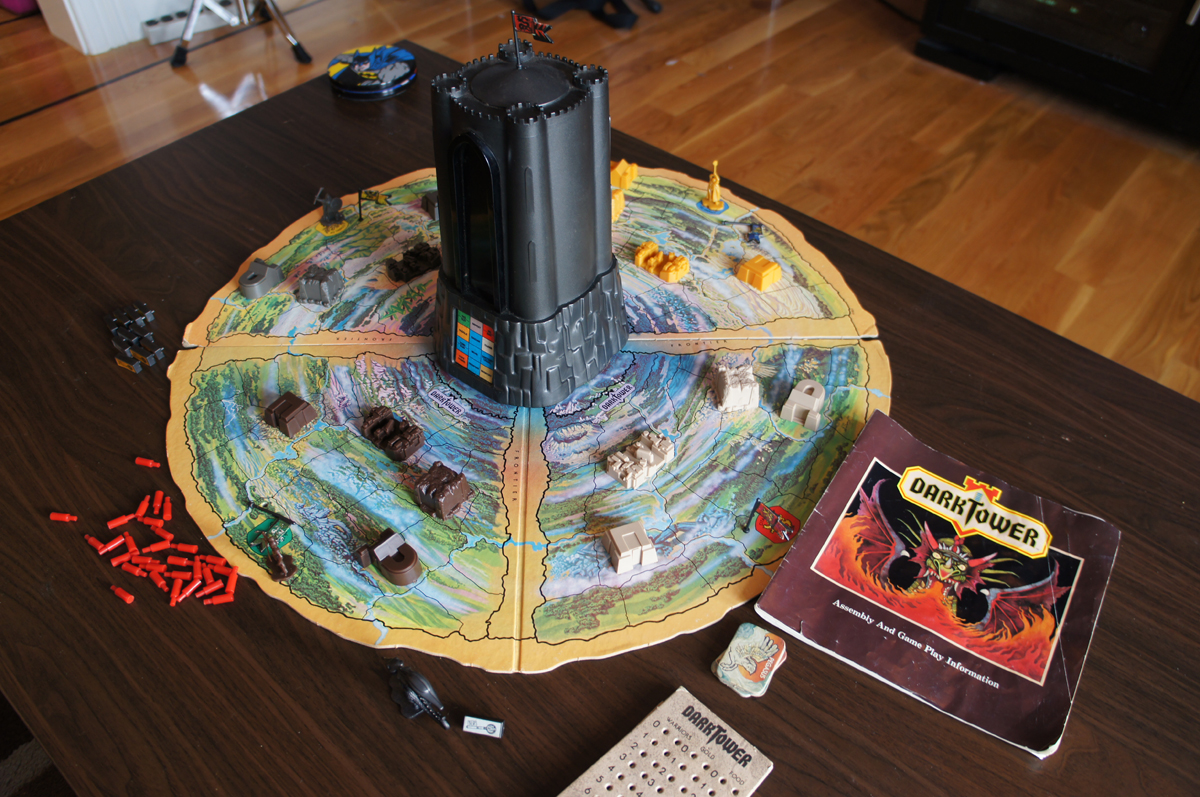
Dark Tower
Perhaps the most fascinating influence of all.
Many Moonstone fans have never heard of Dark Tower, but Todd Prescott directly identified it as one of the key inspirations behind the game’s design. Once you’ve seen it, the similarities are surprisingly obvious: competing adventurers, exploration, resource management, key objectives and a climactic final goal.
In many ways, Dark Tower may be Moonstone’s closest tabletop ancestor.
Barbarian
If Dungeons & Dragons inspired Moonstone’s world, Barbarian inspired its combat.
Todd was refreshingly direct about this, stating that the game’s combat was heavily inspired by Barbarian and that both he and Rob Anderson loved the way it played. The influence is easy to see. Brutal one-on-one fights, oversized weapons, decapitations and a sense that every attack carries weight all found their way into Moonstone.
Even today, the combat in Moonstone feels more committed and dangerous than many modern action games.
Conan, Comics & Fantasy Art
Moonstone’s visual style owes a huge debt to fantasy illustration and comics.
In interviews, Rob Anderson specifically cited:
- Conan comics
- John Buscema
- Alan Lee
- Fantasy illustration in general
as key influences. The result is a world that feels very different from high fantasy epics, especially in terms of its boxart which was hand painted by David ‘Magic: The Gathering‘ O’Connor’s iconic and uniquely whimsical style.
Moonstone’s world is rougher, stranger and often a little darker, existing somewhere between olde British folklore and sword-and-sorcery adventure.
Even today, the combat in Moonstone feels more committed and dangerous than many modern action games.
Barbarian (Death Sword)
Of all the videogame influences behind Moonstone, none may be more significant than Palace Software’s legendary Barbarian.
This isn’t fan speculation. Todd Prescott directly confirmed that Moonstone’s combat was heavily influenced by Barbarian and that both he and Rob Anderson loved the way it played.
Looking back today, the influence is obvious.
Barbarian’s combat was simple, brutal and meaningful. Every attack mattered. Every mistake could be fatal. There were no lengthy combinations, no endless chains of special moves and no unnecessary complexity. Instead, players focused on timing, distance, commitment and positioning.
Moonstone inherited much of that philosophy.
The oversized weapons, deadly melee encounters, memorable decapitations and emphasis on impactful combat all trace part of their lineage back to Barbarian. More importantly, both games understood that attacks should feel weighty and consequential. Even today, many modern games struggle to recreate the sense of commitment and danger that these two classics achieved decades ago.
Battle Chess
Perhaps the most unexpected name on the list.
When discussing the games he remembered most fondly from the period, Rob Anderson specifically mentioned Battle Chess, Interplay’s classic animated chess game.
At first glance, the connection may seem unusual. One is a fantasy action-adventure, the other a board game. But look closer and similarities begin to emerge.
Battle Chess transformed abstract game mechanics into entertaining animated encounters. Every piece had its own personality, with elaborate battle animations turning simple captures into memorable visual events. Moonstone would later apply a similar philosophy to its own combat and death scenes, ensuring that fights were not merely functional but entertaining to watch.
Given Rob’s background in classical animation and his obsession with character movement, it’s easy to see why Battle Chess made an impression. Moonstone’s knights, monsters and famously over-the-top deaths all share the belief that animation should be as enjoyable as gameplay itself.
Fantasia
One influence that surprised me when Rob mentioned it was Disney’s Fantasia.
In particular, the famous “Night on Bald Mountain” sequence seems spiritually connected to much of Moonstone’s atmosphere. Ancient magic, looming supernatural forces, dramatic lighting and the feeling that dark powers are stirring just beyond sight all feel unmistakably Moonstone.
Once you’re aware of the connection, it’s difficult not to see traces of Fantasia’s influence throughout the game’s aesthetic.
Monty Python & Terry Gilliam
The humour in Moonstone wasn’t accidental.
Rob Anderson has spoken about his love for:
- Monty Python and the Holy Grail
- Terry Gilliam
- Terry Jones
Suddenly, many of Moonstone’s stranger moments make sense. Beneath the gore and fantasy atmosphere lies a mischievous sense of humour. Decapitations, bizarre deaths and absurd situations are part of the game’s charm.
Moonstone is dark, but it never takes itself entirely seriously.
Richard Joseph
No discussion of Moonstone’s inspirations would be complete without mentioning the late Richard Joseph.
While he wasn’t involved in the original design process, his soundtrack became inseparable from the game’s identity. Both creators have spoken warmly of Richard’s prior reputation and his ensuing contribution, and it’s impossible to imagine Moonstone without the haunting music (itself inspired by Rob Anderson’s love of Peter Gabriel songs like Rhythm of the Heat), eerie atmosphere and unforgettable audio cues he produced.
His genius when it came to SID and MOD compositions elevated an already special game into something genuinely magical.
More Than The Sum Of Its Influences
What makes Moonstone remarkable is that none of these influences alone explain it.
The game draws from tabletop gaming, fantasy art, comics, cinema, animation, and videogames, yet somehow emerged as something entirely its own. More than thirty-five years after release, players still debate exactly why Moonstone feels so unique.
Perhaps that’s because it never really tried to imitate anything.
Instead, it combined all of these influences into one unforgettable adventure.
“Money can’t buy the kind of feeling you get knowing that other people really like something you made.” – Todd Prescott
And judging by the passion Moonstone still inspires today, that’s a feeling its creators earned many times over.